


No products in the cart.
French Drain vs. Surface Drain: Which Drainage System Does Your Yard Need?
A French drain collects water moving through saturated soil, while a surface drain captures water flowing or pooling on top of the ground. Which one does your yard need? Choose a French drain when water remains below the surface, creates soggy soil, or moves toward a foundation or retaining wall. Choose a surface drain when rainwater gathers in a visible low spot or runs across a patio, driveway, or lawn. Some properties need both systems because surface runoff and underground moisture are separate problems. Homeowners searching for drainage solutions Delta properties may need should first identify where the water comes from and how it travels through the yard. The right choice in a French drain vs surface drain comparison depends on the water source, soil, slope, property layout, and where the collected water can be discharged safely.
What Is the Difference Between a French Drain and a Surface Drain?
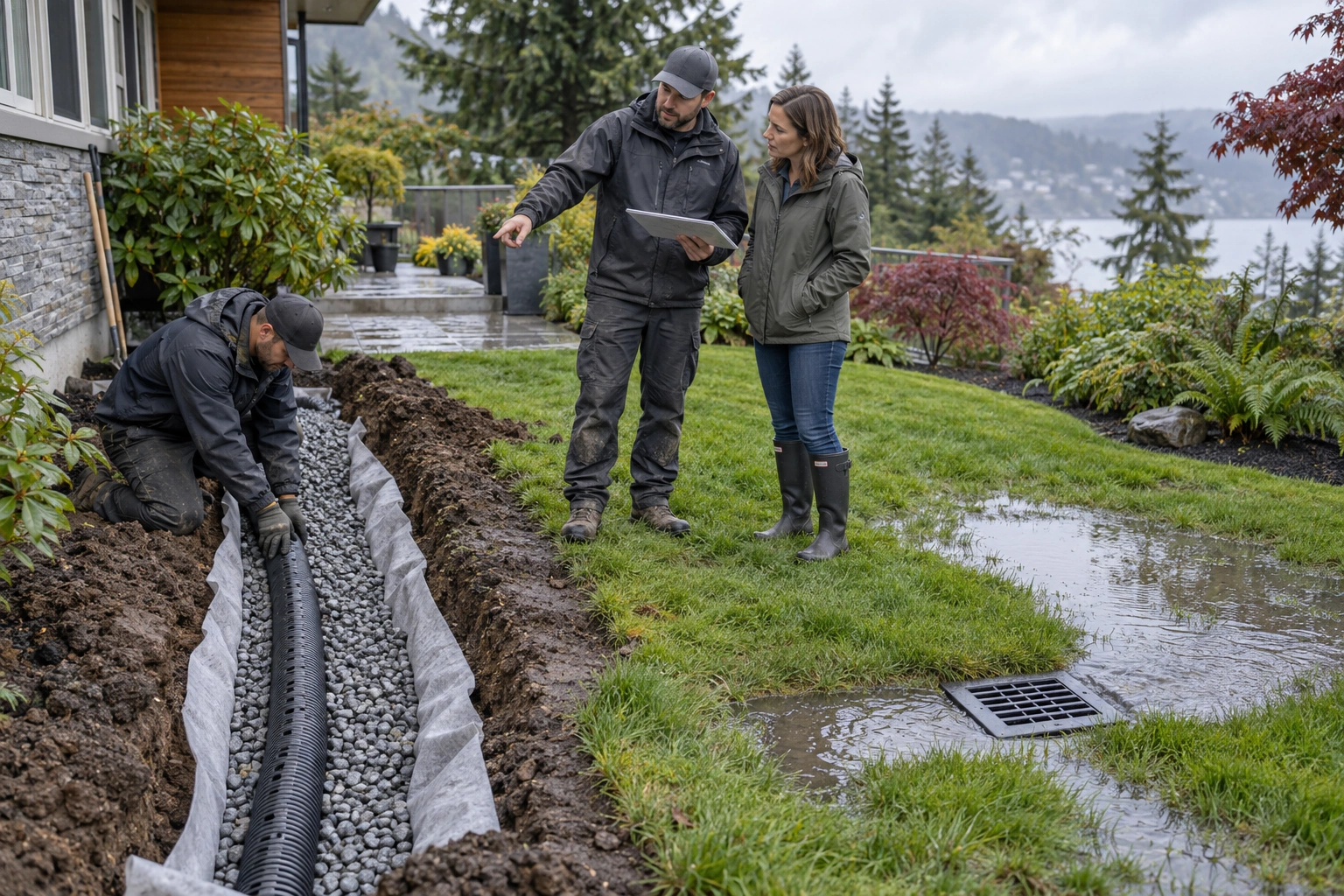
A French drain collects water moving through saturated soil, while a surface drain captures water flowing or pooling above the ground. A French drain usually consists of a gravel-filled trench, filter fabric, and perforated pipe. Water enters through the gravel and pipe openings before being directed toward a suitable outlet. A surface drain normally uses a grated catch basin or channel drain connected to solid pipe. It collects visible runoff from lawns, patios, driveways, and other surfaces. Choose a French drain when moisture moves below ground, creates persistently soggy soil, or travels toward a retaining wall or vulnerable area. Choose a surface drain when water gathers in a defined low spot or flows across a hard surface during rain. Some yards need both because runoff and subsurface moisture are separate problems. The final decision should consider the water source, soil, slope, surrounding structures, pipe capacity, and available discharge route.
How a French Drain Works
A French drain is a gravel-filled trench containing a perforated pipe. Water enters through the gravel and openings in the pipe, then flows toward an approved discharge point. Filter fabric is commonly used to help keep surrounding soil and sediment out of the gravel.
Because it works below ground, a French drain can help beside a retaining wall, along the uphill side of a property, or in a persistently soggy lawn. The pipe needs a suitable slope and outlet. It will not solve the problem if the captured water has nowhere appropriate to go.
How a Surface Drain Works
A surface drainage system collects water that can be seen moving or pooling above ground. It may use a grated catch basin in a low section of lawn, a channel drain across a patio or driveway, or several inlets connected to solid underground pipe.
The grate allows runoff to enter quickly, and solid pipe carries it toward an approved outlet. Surface drainage solutions often work well near hardscaping or in a defined low spot. However, the surrounding grade must direct water toward the inlet.
French Drain vs. Surface Drain Cost Comparison
French drains often require more excavation, gravel, filter fabric, and landscape restoration than a simple surface inlet. For that reason, they may cost more than a small catch basin connected to a nearby outlet. A surface system can still become a larger project when it needs several drains, long pipe runs, concrete cutting, or extensive grading.
The French drain installation cost BC homeowners receive can vary according to trench depth, soil, equipment access, materials, disposal, discharge location, and restoration. Local 2026 drainage cost guidance also identifies depth, access, soil, and restoration as major price factors, showing why an on-site assessment is more useful than a general online estimate.
Ask for an itemized quote that separates excavation, materials, connections, disposal, and restoration. This makes it easier to compare systems and understand why one recommendation costs more.
Which Drainage System Is Better for Your Yard?
Use this decision guide as a starting point:
- Choose a French drain for persistently soggy soil. It can collect moisture moving below the surface and redirect it before the area stays saturated.
- Choose a surface drain for visible pooling. A catch basin can collect water from a defined low spot if the surrounding grade leads toward it.
- Choose a French drain to intercept water moving downhill underground. A properly positioned trench may collect subsurface flow before it reaches a lawn, wall, or foundation area.
- Choose a surface drain for patio or driveway runoff. A channel drain or catch basin can capture water flowing across a hard surface.
- Investigate basement seepage before choosing either system. The cause may involve grading, downspouts, foundation waterproofing, perimeter drainage, cracks, or groundwater. A simple yard drain may not correct the source.
- Consider both systems when the property has two kinds of water. One system can collect visible runoff while the other manages moisture within the soil.
This is a starting point, not a substitute for examining the property during or shortly after rainfall.
What Is the Best Drainage System for Clay Soil?
The best drainage system for clay soil depends on where the water sits. Grading and a surface drain may help when slow absorption creates visible pooling. A French drain may be useful when saturated clay holds water beside a wall or directs underground moisture toward another area. The contractor should also examine slope, water source, saturation depth, outlet options, and nearby structures.
Which Is Better for a Sloped or Flat Yard?
On a slope, a surface drain, swale, or grading correction may manage visible runoff. A French drain may help when underground water creates a wet band across the yard. On flat ground, a catch basin can collect a low area, but its pipe still needs enough fall or another suitable discharge method.
The most useful yard drainage comparison begins with elevation. A contractor can identify high and low points, observe runoff patterns, and determine whether gravity can move water to an approved location.
Can You Combine Both Systems?
Yes. Combining the systems can be useful when a yard experiences both surface runoff and saturated soil. For example, a catch basin might collect water beside a patio while a nearby French drain intercepts moisture moving through an uphill garden bed.
The two systems should be designed as parts of one drainage plan. Connecting components without checking pipe capacity, slope, outlet conditions, and expected water volume may create backups. The contractor should also confirm that roof runoff, surface water, and subsurface drainage are handled in a suitable way for the site.
A combined design may cost more initially, but it can be more effective than expecting one drain to solve two different water problems.
Why a Site Assessment Matters
Water can appear far from its source. Poor grading, runoff from higher ground, compacted soil, a downspout, irrigation, or underground seepage may all create a wet lawn. Installing a drain at the puddle without finding the cause may provide only partial relief.
At Yoho Landscaping, we look at the entire drainage pattern before recommending a system. We consider the slope, soil, hard surfaces, retaining walls, low areas, and available discharge routes. Homeowners can learn more about our drainage solutions and our landscaping services inTsawwassen.
Frequently Asked Questions
Which is cheaper, a French drain or a surface drain?
A simple surface drain is often less expensive because it may require less excavation and gravel. However, a large surface system with multiple catch basins, long pipe runs, concrete work, or regrading can cost more. The final price depends on the complete design rather than the drain name alone.
Do French drains really work?
Yes, a correctly designed French drain can manage subsurface water effectively. It needs suitable placement, filter materials, pipe slope, and a reliable outlet. It may perform poorly if it is installed above the wet zone, becomes clogged with sediment, or has nowhere to discharge the collected water.
How long does drainage installation take?
A small and accessible installation may take one or two working days, while a longer or more complex system can take several days. Clay soil, deep excavation, limited equipment access, utility locations, concrete cutting, weather, and landscape restoration can extend the schedule.
Can a surface drain solve a soggy lawn?
It can help when water pools visibly and the ground can be graded toward the inlet. If the lawn stays wet because moisture is moving through saturated soil, a French drain or a broader grading and soil solution may be more suitable.
Final Thoughts
In the French drain vs surface drain decision, start by identifying where the water is moving. French drains manage moisture within the soil, while surface drains collect runoff above it. Sloped sites, clay soil, patios, low lawns, and foundation concerns may each require a different approach, and some yards benefit from both systems.
If water continues to collect in your yard, contact Yoho Landscaping to get a drainage system recommendation based on the actual slope, soil, runoff, and layout of your property.