


No products in the cart.
Interlocking Pavers vs. Poured Concrete Driveways: Pros, Cons, and Costs
Interlocking pavers usually cost more to install than a basic poured concrete driveway, but they offer greater design flexibility and allow damaged areas to be repaired one unit at a time. Poured concrete often provides a lower upfront price and a clean, continuous surface, yet cracks and settled sections can be difficult to repair without leaving visible patches. In an interlocking pavers vs concrete driveway comparison, neither material is automatically best for every home. Homeowners planning paver installation Delta projects should consider their budget, expected vehicle use, drainage, maintenance preferences, desired appearance, and need for future repairability. Proper excavation, grading, drainage, base preparation, and installation matter as much as the surface material itself.
Are Interlocking Pavers Better Than Poured Concrete?
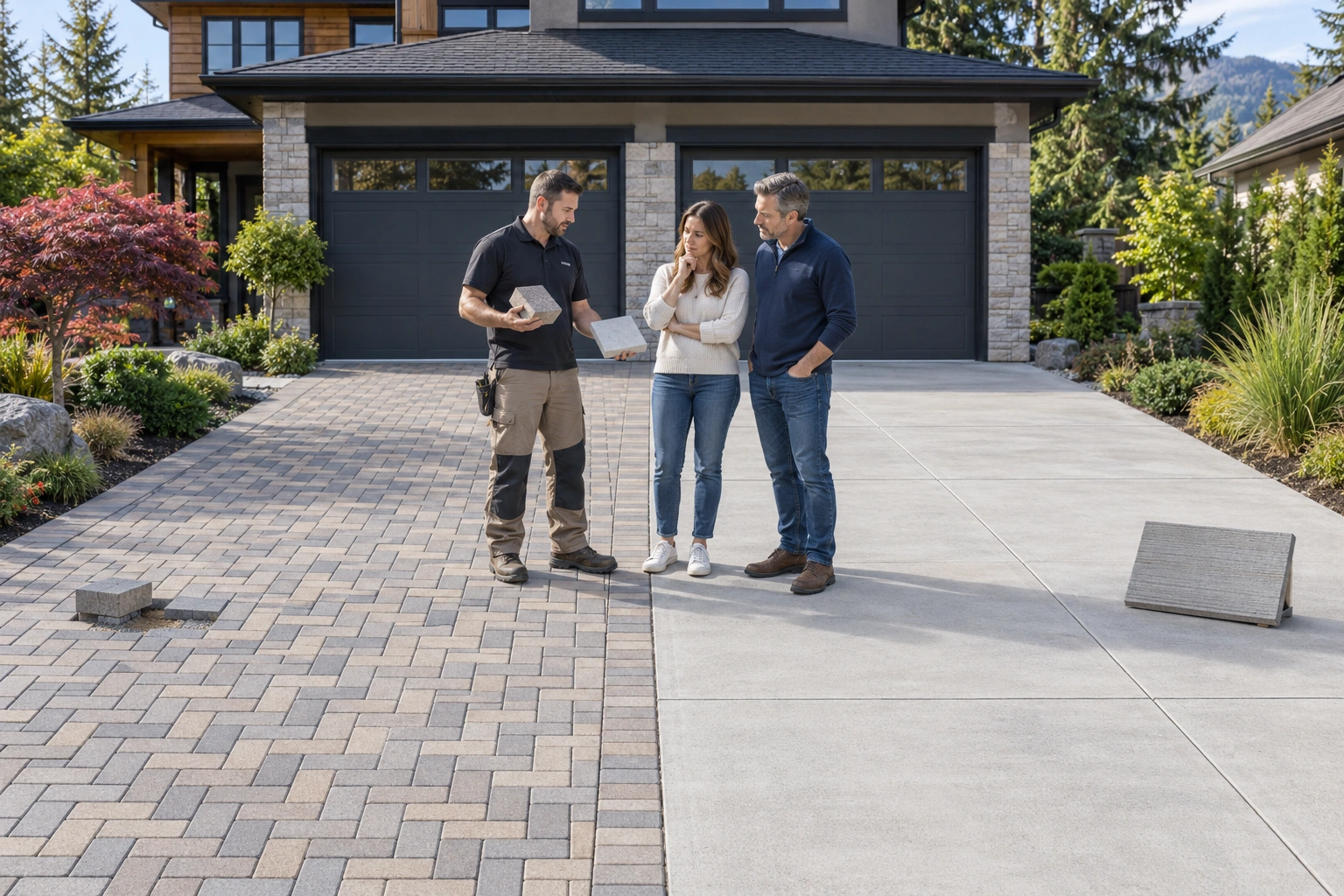
Interlocking pavers are often the better choice for homeowners who value design flexibility, easier localized repairs, and a surface that can adjust to small amounts of ground movement. Poured concrete may be better when the main priority is a lower initial price and a simple, continuous finish. Pavers are individual units installed over a prepared, compacted base. If a section settles or becomes damaged, a contractor can usually lift those units, correct the base, and reinstall them. Concrete is poured as one slab, so cracking or settlement can be more difficult to repair without a visible patch. However, neither material will perform well on a weak base or poorly drained site. Proper excavation, grading, compaction, edge restraint, and water management are essential for both. In an interlocking pavers vs. concrete driveway comparison, choose pavers for repairability, visual variety, and long-term flexibility. Choose concrete for a more economical installation and a clean, uniform appearance. Before deciding, have the site assessed so the quote reflects the soil, slope, drainage, access, demolition, and expected vehicle loads.
How Does an Interlocking Paver Driveway Work?
An interlocking paver driveway uses separate concrete or stone units placed over excavated soil, compacted aggregate, a bedding layer, and edge restraints. Joint material helps the units work as a connected system. The joints can accommodate limited movement better than one rigid slab, but the base still needs suitable depth, compaction, drainage, and edge support. Colors, shapes, and patterns can coordinate the driveway with a walkway, patio, or entrance.
What Are the Pros and Cons of Pavers?
Interlocking pavers are individual concrete units installed over a prepared aggregate base. Joint material and edge restraints help keep the surface stable. Patterns, colours, borders, and textures can complement the home and landscape.
Pros:
- Individual pavers can be lifted and replaced if they become stained or damaged.
- Sections can be opened for underground work and reinstalled afterward.
- Pavers offer more design choices than standard poured concrete.
- Small joints let the surface respond to minor movement without creating one long crack across the driveway.
- Permeable systems may be available where site conditions and local requirements allow them.
Cons:
- The initial installation normally costs more than basic poured concrete.
- Poor base preparation can lead to settlement, uneven areas, or spreading edges.
- Joints may need occasional cleaning or replenishment.
- Weeds or moss can appear where joint material has eroded, or organic debris is allowed to collect.
- Installation involves many individual units and may take longer than a straightforward concrete pour.
Pavers are not maintenance-free, but their modular design makes localized correction possible. Performance still depends on the base, edge restraint, drainage, and installation.
Poured Concrete: Pros and Cons
Poured concrete forms one continuous slab. It may have a basic broom finish or upgrades such as colour, exposed aggregate, scoring, or patterns.
Pros:
- Basic poured concrete often has a lower upfront cost than interlocking pavers.
- It creates a smooth, continuous surface with few joints.
- A simple finish can suit modern and traditional homes.
- Routine maintenance is generally straightforward.
- Decorative finishes can provide more visual interest than plain grey concrete.
Cons:
- Concrete can crack because of settlement, shrinkage, roots, poor drainage, or temperature changes.
- Crack repairs and patches may remain visible.
- A badly damaged section may require cutting and replacing part of the slab.
- Accessing buried utilities can leave a noticeable repair line.
- Decorative finishes raise the price and may require additional care.
Control joints are used to encourage cracking in planned locations, but they cannot guarantee that cracks will never appear elsewhere. Base preparation, reinforcement, slab design, drainage, finishing, and curing all affect performance.
Cost Comparison Per Square Foot
The paver driveway cost BC homeowners pay is usually higher than the price of basic poured concrete. Current 2026 Vancouver estimates list installed interlocking pavers at roughly CAD $18 to $54 per square foot, with an average near $30. The same source estimates poured concrete at approximately CAD $10 to $26 per square foot, averaging near $17. These are broad planning figures, not project quotes. Vancouver paver estimates and Vancouver concrete estimates both note that actual pricing changes with project details.
Costs may also include demolition, excavation, disposal, base preparation, grading, drainage, edge restraints, reinforcement, finish choices, borders, and restoration.
When comparing quotes, make sure each contractor is pricing the same scope. A low estimate may allow less excavation, exclude drainage, or omit removal and disposal. An itemized proposal makes the comparison more useful.
Which Driveway Is Easier to Repair?
Pavers normally offer the simpler path for a localized repair. A contractor can remove the affected units, inspect or rebuild the base, and place the same units back. If matching replacement pavers are available, stained or chipped pieces can also be changed individually.
Concrete repair depends on the problem. Small cracks can sometimes be cleaned and sealed, but sealing does not make them disappear. A settled section may need lifting, stabilization, or replacement. Replacing one portion can leave differences in tone and finish because the original concrete has aged.
Repairability can matter when a driveway crosses utility lines or when soil conditions may create movement. Still, pavers are not immune to settlement. The benefit is that the surface can often be opened and restored with less obvious disruption.
Do Paver Driveways Crack Like Concrete?
Individual pavers can chip or crack, but the surface does not normally develop the same long cracks seen in a slab. If one unit fails, it can usually be replaced. The more common paver issue is unevenness caused by settlement, edge movement, erosion, or poor compaction. Concrete control joints manage shrinkage, but cracks may still form elsewhere. No responsible installer should promise that an outdoor concrete slab will never crack.
Which Option Needs Less Maintenance?
Both surfaces need cleaning and inspection. Pavers may need joint material, weed or moss control, and resetting if an area moves. Concrete may need crack sealing and stain removal. Some decorative surfaces benefit from resealing. Follow the manufacturer’s care guidance, and fix drainage problems instead of repeatedly treating their surface effects.
Which Driveway Has Better Curb Appeal?
Pavers offer contrasting borders, curved layouts, patterns, and coordination with other hardscaping. Concrete provides a quieter, uniform look, while exposed aggregate, color, and stamping add character at extra cost. Consider the house, walkways, steps, walls, and planting beds together so the driveway suits the whole property.
How Do These Materials Perform in Delta’s Climate?
Delta’s wet periods make drainage and base preparation especially important. Water should move away from buildings and low areas toward a suitable outlet. Standard pavers are not automatically permeable. A permeable system requires compatible units, open joints, specific base materials, and a site-appropriate design. Concrete also needs carefully planned slope and joints. With either material, drainage belongs in the original design.
Which Is Better for Heavy Vehicles?
Either system can support passenger vehicles when properly designed. Heavy trucks, recreational vehicles, or frequent service traffic may require a deeper base, thicker concrete, reinforcement, or suitable paver thickness. Tell the contractor about loads, turning areas, and long-term parking before design begins.
How Long Does Driveway Installation Take?
The schedule depends on size, demolition, excavation, weather, access, drainage, and design. A 2026 Vancouver guide places many interlocking projects in a three- to ten-day range and concrete work around three to seven days plus curing time. These are planning references only. Homeowners arranging paver installation Delta should also allow time for material selection, utility checks, and scheduling.
Our Recommendation by Homeowner Priority
Choose interlocking pavers when design flexibility, localized repair, and integration with other hardscaping are top priorities. They may also suit homeowners who expect future access beneath the driveway or want the option to replace individual units.
Choose poured concrete when the main priorities are a lower initial price, a simple continuous surface, and straightforward maintenance. Basic concrete can be a practical choice when the site has stable preparation, suitable drainage, and a design that does not require extensive customization.
Consider decorative concrete when you want more visual interest but prefer a continuous slab. Compare its total price with pavers because added colour, exposed aggregate, or pattern work can narrow the cost difference.
Final recommendation: choose pavers for repairability and design freedom, or choose concrete for a simpler surface and typically lower upfront cost. Whichever material you select, invest in the base and drainage first.
Why Choose Yoho Landscaping for Driveway Renovation?
At Yoho Landscaping, we look beyond the visible surface. A dependable driveway begins with an assessment of the existing grade, drainage, soil, access, and base conditions. We use those details to discuss suitable driveway renovation options rather than recommending a material based only on appearance.
Homeowners can learn more about our driveway paving and renovation service and view examples in our driveway project portfolio. We also provide professional landscaping services in Coquitlam and landscaping services in Ladner for homeowners planning driveway improvements and other outdoor projects.
Our goal is to help clients compare the practical trade-offs and choose a design suited to their property, priorities, and budget.
Frequently Asked Questions
Are pavers more expensive than concrete long-term?
Pavers generally cost more at installation, but their repairability may reduce the disruption and expense of fixing a localized problem later. Concrete begins at a lower price in many projects, yet major cracking or settlement can require a larger section to be replaced. Long-term cost depends on installation quality, drainage, use, maintenance, and the type of repairs needed.
Do paver driveways crack like concrete?
Individual concrete pavers can chip or crack, but the driveway does not behave like one continuous slab. Movement is distributed through the joints, and a damaged unit can usually be replaced. Pavers may still settle or shift if the base, edge restraint, or drainage is inadequate.
How long does a paver driveway installation take?
Many residential paver driveways take several working days to install. A large or complex project may take longer. Demolition, excavation, site access, base depth, drainage work, cutting, patterns, weather, and edge details all affect the schedule. The contractor should provide a project-specific timeline after inspecting the site.
Which driveway requires less maintenance?
Basic concrete usually requires less routine joint care, although cracks and stains still need attention. Pavers may need joint maintenance and cleaning, but localized repairs are easier. The better choice depends on whether the homeowner values simpler routine care or easier future repair.
Final Thoughts
The interlocking pavers vs concrete driveway decision comes down to priorities. Pavers offer design flexibility and repairable sections, while concrete provides a continuous surface at a generally lower starting cost. Both can perform well when the base, grading, drainage, and installation are handled correctly.
Schedule a free driveway consultation with Yoho Landscaping to compare materials, discuss site conditions, and receive a recommendation shaped around your Burnaby or Lower Mainland property.