


No products in the cart.
Retaining Wall Materials Compared: Concrete Block vs. Natural Stone vs. Timber
Should you choose the retaining wall material that looks best, costs less, or is expected to last longer? The answer is rarely based on appearance alone. With retaining wall materials compared side by side, concrete blocks often provide the most balanced combination of strength, design choice, and repairability. Natural stone offers a premium look and excellent durability, while timber can be practical for lower walls and tighter budgets. At Yoho Landscaping, we also consider the conditions people cannot see in a finished photo. For retaining wall construction Delta, drainage, soil pressure, wall height, nearby loads, access, and base preparation can matter more than the visible material.
What Is the Best Material for a Retaining Wall?
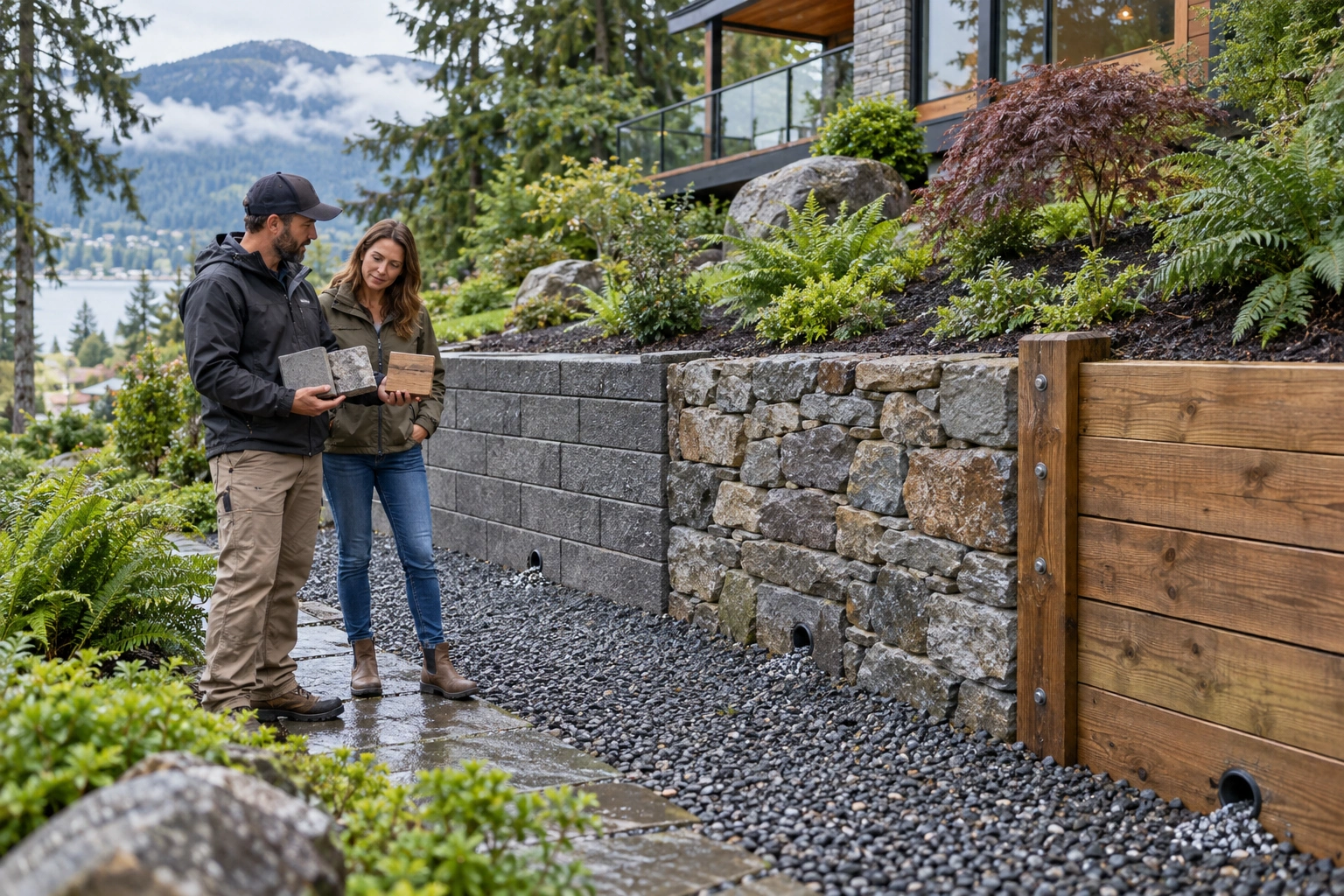
The best retaining wall material depends on the wall’s purpose, height, soil, drainage, appearance, budget, and expected service life. Concrete block is often the most practical all-around option because manufactured units create a consistent system, offer several styles, and can be reinforced when the design requires it. Natural stone may be the best choice when a homeowner wants a distinctive, high-end appearance and is prepared for skilled installation, heavier materials, and a higher project cost. Timber can work well for lower garden walls or simpler landscape features where warmth and a lower initial price matter, but constant soil and moisture exposure can shorten its useful life. None of these materials will perform properly without a stable base, appropriate backfill, and a way to manage water behind the wall. Taller walls, steep properties, and walls supporting driveways or structures may also require professional design and municipal approval. Start with the site conditions, then compare materials that are suitable for the actual load and environment.
How Do Concrete Block Retaining Walls Work?
A concrete block wall uses manufactured units placed in level courses over a compacted base. Many systems use a lip, pin, or shape that creates a controlled setback. Drainage aggregate and filter fabric help manage water and separate soil from the drainage zone.
Depending on height, slope, soil, and nearby loads, the design may also use geogrid extending into the retained soil. Product specifications or engineered plans determine its placement. Predictable block dimensions help with curves, steps, corners, and caps, but excavation, compaction, drainage, reinforcement, and backfill still determine performance.
What Are the Pros and Cons of Concrete Block Retaining Walls?
Concrete block balances practical performance with design flexibility. Homeowners can choose among several colors, textures, cap styles, and layouts. Individual units may be replaceable, although correcting movement can require rebuilding the base or reinforced soil.
The material looks more manufactured than stone, and older blocks may be difficult to match. Poor preparation can cause movement regardless of block quality.
The concrete block retaining wall cost is usually higher than a basic timber wall but lower than premium cut stone or complex masonry. It is often a strong middle option for homeowners seeking a structured appearance and a system that can suit many residential applications.
How Much Does a Concrete Block Retaining Wall Cost?
Installed prices vary widely because a retaining wall is priced as a complete system, not just a stack of blocks. A recent Metro Vancouver guide lists broad 2026 planning estimates of about CAD $55 to $95 per square foot of visible wall face for modular concrete block, about $45 to $70 for pressure-treated timber, and higher ranges for boulder or cut-stone options. These figures are not Delta quotes and should only be used for early comparison.
Wall height, curves, demolition, disposal, access, base depth, drainage, geogrid, engineering, permits, steps, and restoration can all change the total. Ask for an itemized proposal because a lower price may omit drainage, reinforcement, or cleanup.
How Do Natural Stone Retaining Walls Work?
Natural stone walls may use boulders, fitted dry stone, or cut stone installed with mortar. Each approach manages loads differently. Pieces need stable support, a prepared foundation, and placement that resists sliding or rotation. Heavy stone may require machinery and suitable access.
For a natural stone retaining wall BC homeowners often value how stone blends with gardens and established landscapes. That uniqueness also makes material selection and labor less predictable.
What Are the Pros and Cons of Natural Stone Retaining Walls?
Natural stone creates a distinctive wall with variations that suit informal gardens and premium landscapes. Suitable stone can be highly durable and may age attractively. The trade-offs are cost, access, and complexity. Heavy pieces need equipment, fitted stone requires skilled labor, and irregular material may use more space. Mortared joints can also deteriorate when movement occurs.
How Do Timber Retaining Walls Work?
Timber walls commonly use pressure-treated members supported with posts, anchors, or tie-backs as required. A compacted base, drainage material, and suitable outlet help control water. Timber is lighter than stone and creates a warm appearance, but even treated wood faces demanding conditions beside damp soil.
What Are the Pros and Cons of Timber Retaining Walls?
The main timber retaining wall pros and cons involve initial cost, appearance, and longevity. Timber often costs less and may be faster to install for a straightforward low wall. However, wood can decay, split, warp, or suffer insect damage. Posts and lower members may deteriorate before the problem is visible, and replacement can require excavation and new backfill.
Timber is generally more suitable for modest walls than locations supporting buildings, driveways, or other major loads.
Which Retaining Wall Material Lasts the Longest?
Natural stone and concrete blocks generally offer better long-term durability than timber when properly designed and installed. Stone and concrete resist decay, while moisture and soil contact gradually affect wood. Still, blocks or stone can move when the base settles, water builds up, reinforcement is inadequate, or loads exceed the design. Treat exact lifespan promises cautiously because drainage, soil, workmanship, maintenance, and nearby changes all affect performance.
What Is the Best Retaining Wall Material for Rain?
The best retaining wall material for rain is a suitable structural system paired with effective drainage. Concrete blocks and natural stone do not rot, which gives them an advantage over timber in consistently wet conditions. Still, neither material can safely solve trapped water by itself.
Rainwater can saturate the soil and create pressure behind a wall. Drainage aggregate provides a freer path for water, while filter fabric separates it from surrounding soil. A base drain may carry water toward an appropriate outlet, and surface grading should direct runoff away when possible.
Timber requires especially careful moisture management because repeated wetting can contribute to decay. For retaining wall construction Delta, we recommend choosing the material only after identifying where water comes from and where it can be discharged appropriately.
How Does Drainage Affect Retaining Wall Performance?
Water behind a wall adds force to the soil it retains. Saturated soil can push harder than drained soil, while moving water may carry fine particles away or soften the supporting ground.
A drainage plan may include free-draining backfill, filter fabric, perforated pipe, outlets, and grading. The design depends on the property. A pipe without suitable slope, capacity, and discharge is not a complete solution.
At Yoho Landscaping, we examine water movement during the wall assessment. Homeowners can also explore our drainage solutions.
Which Retaining Wall Material Looks Best?
Natural stone provides variation and can blend into gardens. Concrete block offers a clean, predictable appearance with several colors and textures. Timber brings warmth and can coordinate with fences or decks. The wall should also suit nearby patios, stairs, paths, driveways, and buildings without ignoring practical construction needs.
How Should You Compare Retaining Wall Quotes?
Use the same questions for each contractor so the quoted scopes can be compared fairly:
- What material, product line, dimensions, caps, and finishes are included?
- How much excavation and soil disposal does the quote cover?
- What base depth, materials, and compaction method are specified?
- How will drainage aggregate, filter fabric, pipe, and outlets be handled?
- Is geogrid, anchoring, or other reinforcement included where required?
- Are engineering, permits, inspections, and utility checks included or excluded?
- Who is responsible for access, protection, cleanup, and landscape restoration?
- What warranty applies, and how will changes or hidden conditions be priced?
The cheapest visible material may not create the lowest complete project cost. Access and preparation can narrow the difference between materials.
Does a Retaining Wall in Delta Require a Permit?
According to the City of Delta’s building and renovation guidance, a building permit is required for a retaining wall that is at least 1.2 meters, or 3 feet 11 inches, high. A permit is also required for retaining walls on designated steep-slope properties regardless of height.
Structures, setbacks, loads, and other site conditions may affect requirements. Confirm current rules with Delta’s Building Division before construction. Taller or more complex walls may also require engineering or other professional input.
Why Is a Site Assessment Important?
A contractor should examine wall height, soil, slope, water, nearby structures, boundaries, trees, utilities, access, and any existing wall. A driveway-supporting wall faces different demands from a garden terrace. For retaining wall construction Delta, this assessment also reveals how materials will reach the work area and where excavated soil can go.
Why Choose Yoho Landscaping for Retaining Wall Construction?
At Yoho Landscaping, we look beyond the wall face. We consider the slope, soil, drainage, access, intended purpose, and surrounding landscape before discussing materials. Our goal is to explain the trade-offs clearly and develop a scope that fits the actual property.
Homeowners can learn more about our retaining wall construction service, read about Yoho Landscaping, and explore our completed landscaping projects. For clients comparing options for retaining wall construction Delta, we focus on thoughtful planning, practical recommendations, and clear communication from the initial assessment onward.
Do We Serve Areas Near Delta?
Yes. Along with Delta, homeowners can explore services in Ladner, New Westminster, Burnaby, and Coquitlam.
Frequently Asked Questions
Is concrete block better than timber for a retaining wall?
Concrete blocks are often better when durability, reinforcement options, and moisture resistance matter. Timber may offer a lower starting cost and warmer appearance for a modest wall. The choice depends on height, loading, drainage, budget, and replacement expectations.
Is natural stone suitable for a retaining wall?
Yes. Natural stone can form a durable, attractive wall when the foundation, drainage, geometry, and installation suit the site. Large pieces may require equipment and skilled placement, and some stone walls use more space than modular block.
What is the most affordable retaining wall material?
Timber often has the lowest initial cost for a simple low wall. However, access, excavation, drainage, disposal, permits, and future replacement affect the total. Compare complete scopes, not material prices alone.
How Long Does Retaining Wall Construction Take?
A small, accessible wall may take several working days. Demolition, difficult access, drainage, engineering, inspections, stonework, weather, and soil conditions can extend the schedule. A site assessment is needed for a dependable estimate.
Does Every Retaining Wall Need Drainage?
Most walls retaining soil need a planned way to manage water. The components and outlet depend on the material, height, soil, slope, and surrounding drainage. Decorative walls that retain little or no soil may have different needs, but water should still be considered.
Final Thoughts
Concrete block balances strength and design choice. Natural stone provides distinctive character and durability. Timber may suit lower budgets, but moisture and future replacement deserve consideration.
The visible material is only part of the decision. Base preparation, drainage, reinforcement, and construction quality determine performance.
If you are planning a new wall or replacing one that is leaning, deteriorating, or poorly drained, reach out to Yoho Landscaping to request a retaining wall site assessment. We can review the slope, water movement, access, and design priorities before recommending a suitable option.