


No products in the cart.
Natural Stone vs. Concrete Pavers: Which Is Right for Your BC Home?
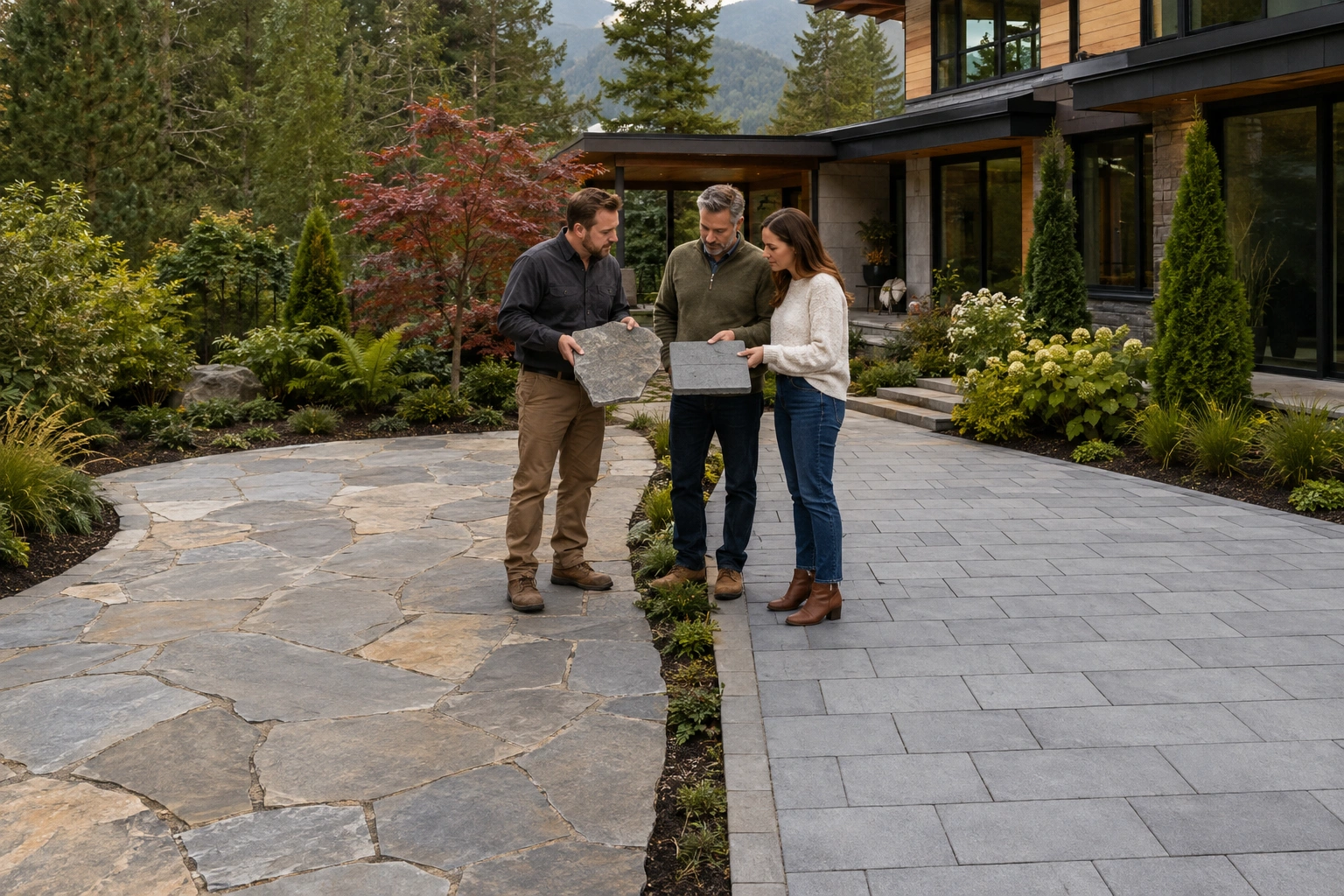
In short, natural stone offers a more organic, distinctive appearance, while concrete pavers provide greater consistency, design flexibility, and often a lower upfront cost. For many BC homeowners, concrete pavers are the practical choice for patios and walkways, while natural stone is ideal when a premium, natural look is the priority. The right option depends on budget, use, maintenance, and site conditions.
Both materials can create beautiful outdoor spaces, but they are not interchangeable.
The Lower Mainland’s wet climate, occasional freezing temperatures, moss growth, drainage challenges, and varied property grades all need to be considered before choosing a material.
Natural Stone vs. Concrete Pavers at a Glance
| Factor | Natural Stone | Concrete Pavers |
| Appearance | Organic, unique, premium | Consistent, structured, wide variety |
| Design flexibility | High | Very high |
| Upfront cost | Generally higher | Generally moderate |
| Installation | Can be more labour-intensive | Generally more predictable |
| Repairs | Individual pieces can be replaced | Individual pavers can be replaced |
| Maintenance | Depends on stone type and finish | Relatively straightforward |
| Weather performance | Good with proper installation | Good with proper installation |
| Best for | Premium, natural landscapes | Versatile residential hardscaping |
The important point is that installation quality matters as much as material selection.
A high-quality paver installation with a properly prepared base and effective drainage can outperform a poorly installed premium material.
Appearance and Design Flexibility
The most obvious difference is visual.
What Does Natural Stone Look Like?
Natural stone has variations in:
- Colour
- Texture
- Shape
- Veining
- Surface finish
- Pattern
These variations give stone its distinctive appearance.
Instead of looking manufactured, natural stone can make a patio, pathway, retaining wall, or garden feature feel integrated with the surrounding landscape.
This can work particularly well with properties that already use natural materials.
Natural stone is often a strong choice if you want:
- An organic landscape
- A high-end appearance
- Unique material character
- A less uniform patio
- A strong connection between hardscape and planting
What Do Concrete Pavers Look Like?
Concrete pavers are manufactured to consistent specifications, which provides a different aesthetic.
You can choose from numerous:
- Shapes
- Sizes
- Colours
- Textures
- Patterns
- Border styles
That consistency makes concrete pavers particularly versatile.
A homeowner can create a clean contemporary patio or a more traditional design without the irregularity associated with natural stone.
For modern homes, large-format or clean-edged pavers can create a particularly streamlined appearance.
For traditional properties, smaller pavers and contrasting borders can provide more visual detail.
Which Is More Expensive: Natural Stone or Concrete Pavers?
Natural stone is generally more expensive than standard concrete pavers, although the final cost depends heavily on the specific material, site conditions, design, and installation requirements.
Natural stone can involve more material selection and labour because pieces may vary in size and shape.
Concrete pavers are manufactured for installation, which can make layout and installation more predictable.
However, material cost should not be considered in isolation.
Your total project price can also include:
- Excavation
- Disposal
- Base preparation
- Drainage
- Edge restraints
- Bedding material
- Labour
- Cutting
- Pattern complexity
- Site access
A simple natural stone design may therefore cost differently from a highly detailed concrete paver installation.
Natural Stone Landscaping Cost vs. Concrete Pavers
There is no single price that applies to every project.
Natural stone landscaping costs can vary significantly based on the type of stone selected and how it will be used.
A premium stone patio with intricate cuts and difficult access will naturally require a different budget from a straightforward paver walkway.
Similarly, a concrete paver patio with multiple borders, curves, steps, and drainage features may cost considerably more than a basic rectangular installation.
For that reason, homeowners should compare complete project scopes, not simply the price of the material per square foot.
Durability in the Lower Mainland Climate
BC’s climate presents several challenges for outdoor hardscaping.
Rainfall is one of the biggest.
Water needs to drain effectively through and around the installation rather than accumulating beneath the surface.
Freezing temperatures can also affect hardscaping when water enters gaps or saturated areas and then freezes and expands.
Moss and organic growth are another consideration in shaded, damp areas.
How Natural Stone Handles BC Weather
Natural stone can be highly durable when the appropriate material is selected and installed correctly.
However, different stones have different characteristics.
The stone’s porosity, surface, thickness, installation method, and exposure all matter.
Proper drainage is particularly important.
Water should not be allowed to remain beneath or around the installation unnecessarily.
How Concrete Pavers Handle BC Weather
Concrete pavers are also well suited to residential hardscaping when properly installed.
One of their major advantages is repairability.
If a section becomes damaged or settles, individual pavers can generally be removed, the underlying area corrected, and the pavers reinstalled or replaced.
That is different from a single poured concrete slab, where cracking or settlement can be more difficult to address without visible repair work.
Installation Time and Process Differences
Both natural stone and concrete pavers require proper site preparation.
The basic process usually involves assessing the site, establishing the layout, preparing the base, addressing drainage, installing the surface, and completing the edges and joints.
Natural Stone Installation
Natural stone installation can require additional attention to individual pieces.
Because the pieces may vary in shape and thickness, the installer needs to work with those variations rather than assuming every unit will fit identically.
This can make the process more labour-intensive.
The final result can be worth it when the goal is a distinctive, handcrafted appearance.
Concrete Paver Installation
Concrete pavers are manufactured to work as a system.
Their consistent dimensions can make it easier to establish a pattern and maintain uniform joints.
This can make installation more predictable, particularly for larger patios and pathways.
However, complicated patterns, borders, curves, and cutting can still add time and labour.
Maintenance Requirements
Neither material is completely maintenance-free.
The amount of maintenance depends on exposure, shade, drainage, surrounding vegetation, and how heavily the surface is used.
Maintaining Natural Stone
Natural stone may require:
- Regular sweeping
- Cleaning
- Weed removal
- Moss management
- Periodic inspection
- Sealing where appropriate for the particular stone
Sealing is not automatically required for every type of natural stone.
The correct maintenance approach depends on the material.
Maintaining Concrete Pavers
Concrete pavers generally require:
- Sweeping
- Occasional cleaning
- Weed control
- Moss removal
- Joint maintenance
- Periodic inspection
- Re-sanding where necessary
If joints lose their sand over time, they may need to be replenished.
Sealing can also be considered depending on the paver product, desired appearance, and maintenance goals.
Natural Stone vs. Concrete Pavers: Which Is Easier to Repair?
Both materials can be repaired, but the process differs.
With concrete pavers, individual units can typically be lifted from the installation.
This is particularly useful when a small area settles because of movement or an underlying drainage issue.
The affected section can be addressed without necessarily rebuilding the entire patio.
Natural stone can also be repaired by replacing damaged pieces, but matching the exact colour, texture, thickness, and appearance of existing stone can sometimes be more difficult.
This is particularly relevant with older installations where the original material may no longer be available.
Side-by-Side Comparison
| Feature | Natural Stone | Concrete Pavers |
| Visual character | Highly natural and unique | Consistent and versatile |
| Colour variation | Naturally occurring | Manufactured and predictable |
| Shapes | Irregular or varied | Standardised options |
| Design styles | Organic and premium | Traditional to contemporary |
| Initial material cost | Generally higher | Generally lower |
| Installation complexity | Can be higher | Generally more predictable |
| Individual repairs | Possible | Usually straightforward |
| Matching replacement pieces | Can be challenging | Usually easier |
| Maintenance | Moderate, material-dependent | Moderate |
| Moss management | May be required | May be required |
| Best advantage | Natural beauty | Versatility and repairability |
Which One Should You Choose?
The answer depends on what matters most to you.
Choose Natural Stone If:
- Appearance is your highest priority
- You prefer organic materials
- You want every piece to have individual character
- Your landscape has a natural or premium design
- You are comfortable with a potentially higher budget
- You want the hardscape to blend naturally with planting and stone features
Natural stone can be particularly effective for feature patios, garden pathways, terraces, steps, and landscape focal points.
Choose Concrete Pavers If:
- You want more predictable pricing
- You prefer consistent shapes and sizes
- You want a wide range of design options
- Repairability is important
- You want a structured contemporary or traditional appearance
- You are installing a larger patio, walkway, or driveway
Concrete pavers are especially versatile for residential projects where multiple hardscaping elements need to work together.
Consider Both If You Want a Mixed-Material Design
You do not necessarily have to choose one material for the entire property.
A landscape can combine materials strategically.
For example:
- Concrete pavers for a main patio
- Natural stone for steps
- Natural stone accents around planting areas
- Pavers for pathways
- Stone retaining walls
- Complementary stone borders
Using materials selectively can create visual interest without requiring the entire project to use the most expensive option.
Which Is Better for a BC Home?
There is no universal winner.
For homeowners prioritising natural appearance and premium character, natural stone can be the better choice.
For homeowners prioritising versatility, predictable installation, design options, and easier individual repairs, concrete pavers are often the more practical choice.
The most important consideration is not simply which material looks better in a catalogue.
It is whether the complete installation is appropriate for your property.
That means considering:
- Soil conditions
- Drainage
- Existing grading
- Patio or pathway use
- Property access
- Material selection
- Base preparation
- Maintenance expectations
- Overall landscape design
- Budget
Why Installation Matters in the Lower Mainland
A premium material cannot compensate for poor preparation.
For both natural stone and concrete pavers, the underlying system matters.
If the base is unstable, the surface can settle.
If drainage is inadequate, water can accumulate.
If the grade is incorrect, water may move toward the home instead of away from it.
If edge restraints are inadequate, pavers can shift over time.
This is why a professional installation should begin with an assessment of the property rather than simply selecting a material.
Yoho Landscaping provides natural stone landscaping Burnaby and paver installation and design as part of its hardscaping services. The company’s broader landscaping capabilities allow these materials to be incorporated with other features such as patios, pathways, retaining walls, and drainage solutions.
For homeowners considering a complete landscape renovation, coordinating these elements during the design stage can produce a more cohesive result.
Frequently Asked Questions
Is natural stone more expensive than pavers?
Generally, yes. Natural stone typically has a higher material and installation cost than standard concrete pavers, although the actual difference depends on the type of stone, paver product, design complexity, site preparation, drainage, access, and labour.
Which lasts longer, natural stone or concrete pavers?
Both can provide long-term service when properly selected and installed. Lifespan depends heavily on the material, installation quality, drainage, soil conditions, maintenance, and exposure. Neither material should be judged on durability alone without considering the quality of the underlying installation.
Do concrete pavers look cheap?
Not necessarily. Modern concrete pavers are available in a wide range of colours, textures, shapes, sizes, and patterns. A well-designed installation can look high-end, particularly when pavers are combined with contrasting borders, thoughtful patterns, landscaping, and quality finishing.
Are concrete pavers good for the BC climate?
Yes. Concrete pavers can perform well in the Lower Mainland when they are installed over a properly prepared base with suitable drainage. Their ability to be individually removed and replaced is also useful if local settlement or damage occurs.
Does natural stone need to be sealed?
Not every natural stone requires sealing. Whether sealing is appropriate depends on the specific stone, surface finish, location, and desired maintenance or stain resistance. The manufacturer’s recommendations should be followed for the selected material.
Making the Right Material Choice for Your Home
The choice between natural stone vs. concrete pavers ultimately comes down to balancing appearance, budget, durability, maintenance, and how the space will be used.
Natural stone offers a one-of-a-kind appearance and can be an excellent fit for homeowners who want a more organic, premium landscape.
Concrete pavers offer consistency, versatility, extensive design options, and practical repairability, making them a strong choice for many residential patios, pathways, and driveways.
If you are unsure which material fits your property, a site assessment can help you compare the options based on your actual conditions rather than generic pricing or appearance alone.
Planning a patio, pathway, driveway, or other hardscaping project in the Lower Mainland? Contact Yoho Landscaping for a free material consultation and discuss which surface solution is right for your home.