


No products in the cart.
Yard Drainage 101: Why Lower Mainland Homes Need Proper Drainage Solutions
The Lower Mainland’s heavy rainfall, clay-rich soils, and naturally varied terrain can make yard drainage a serious concern for homeowners. Effective yard drainage solutions in BC help move excess water away from lawns, patios, retaining walls, and foundations before pooling, erosion, and water damage become bigger problems. The right solution depends on where the water comes from, where it collects, and how the property is graded.
Why Is Yard Drainage So Important in the Lower Mainland?
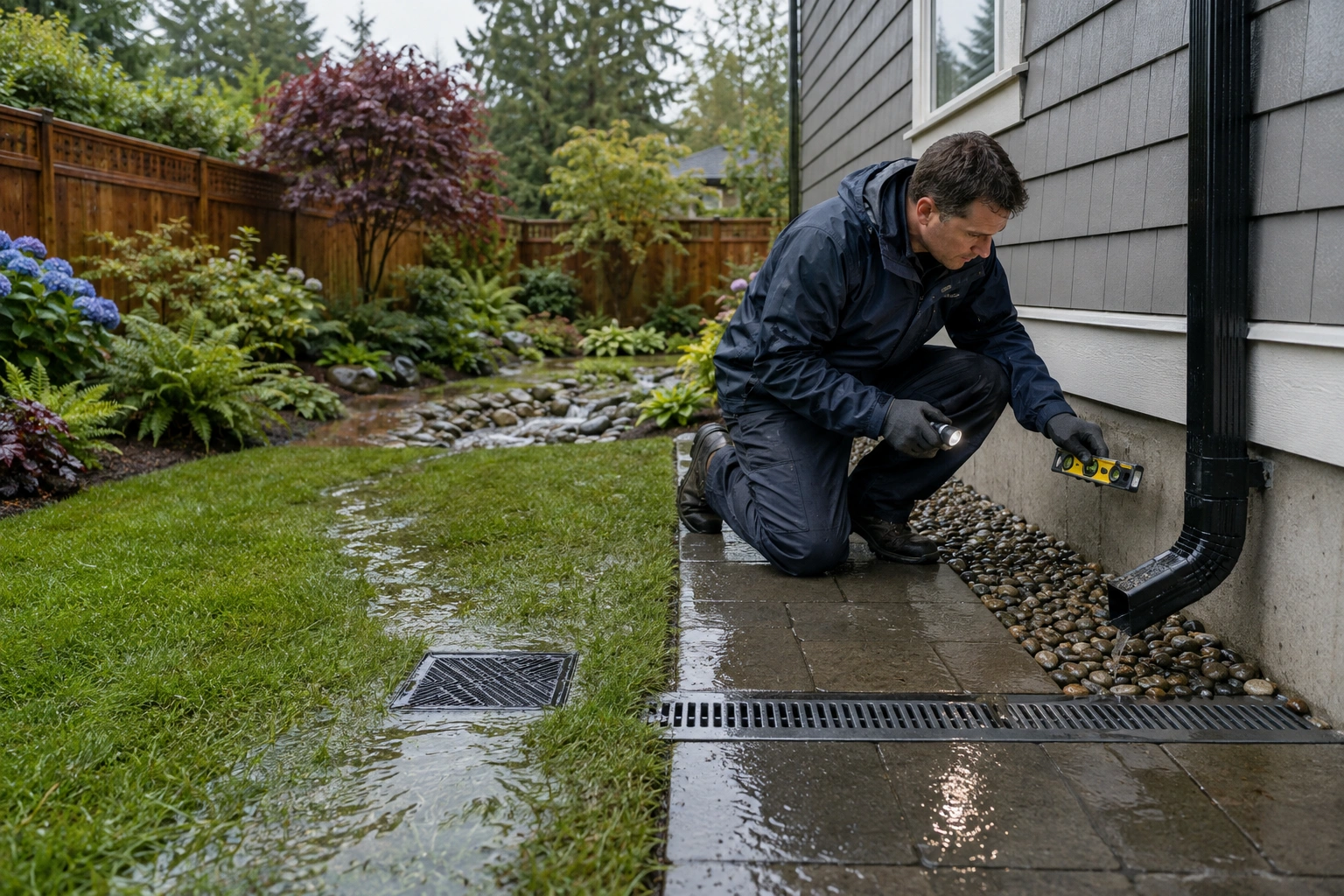
Rain is a normal part of life in British Columbia, but a yard that cannot move water efficiently can develop problems quickly.
Properties in Burnaby, New Westminster, Delta, and surrounding Lower Mainland communities can have a combination of:
- Heavy seasonal rainfall
- Clay or compacted soils
- Sloped or uneven yards
- Limited natural drainage
- Dense landscaping and hardscaping
- Older drainage systems
- Poor grading around structures
When water has nowhere to go, it tends to find the lowest point.
That may be a lawn, garden bed, patio, driveway, crawl space, or the area directly beside your home’s foundation.
Good drainage is therefore not simply about keeping your lawn dry. It is about managing water throughout the property.
5 Signs Your Yard Has a Drainage Problem
Not every puddle means you need a new drainage system.
However, recurring water problems are worth investigating, particularly when they appear in the same location after rainfall.
1. Water Pools in the Yard
If water regularly remains on your lawn long after the rain stops, the soil may not be draining effectively.
Occasional puddles after an unusually heavy storm may not indicate a major issue.
Persistent pooling is different.
It can indicate poor grading, compacted soil, high groundwater, or insufficient drainage capacity.
2. Your Yard Becomes Muddy
A lawn that stays saturated can become soft and muddy.
Repeated foot traffic over wet ground can make the problem worse by compacting the soil and reducing its ability to absorb water.
Over time, you may notice thinning grass, bare patches, moss, or areas where plants struggle to grow.
3. Water Flows Toward Your Home
This is one of the more important warning signs.
If rainwater naturally moves toward your foundation rather than away from it, the property’s grading may need attention.
Water accumulating around the foundation can increase the risk of moisture entering below-grade areas.
4. Your Patio or Walkway Holds Water
Standing water on a patio or walkway can indicate inadequate slope, blocked drainage, settlement, or surrounding grading problems.
It can also make outdoor areas slippery and accelerate moss or algae growth.
5. Soil Is Eroding or Washing Away
Look for:
- Exposed roots
- Small channels in the soil
- Washed-out garden beds
- Exposed aggregate
- Soil accumulating in unexpected areas
- Mulch being carried away after rain
These can indicate that water is moving through the property too quickly or without adequate control.
What Causes Poor Drainage in Burnaby, New Westminster, and Delta Yards?
Drainage problems rarely have just one cause.
Understanding the source is important because installing a drainage system without addressing the underlying problem may only provide a temporary solution.
Clay and Compacted Soil
Clay-heavy soil can drain more slowly than loose, well-structured soil.
Compaction can make this worse by reducing the spaces through which water can move.
Construction activity, heavy equipment, repeated foot traffic, or years of use can all contribute to soil compaction.
Poor Grading
Ideally, surface water should be directed toward an appropriate drainage area rather than allowed to collect beside structures.
If the yard slopes toward the home, water may naturally move in the wrong direction.
Correcting the grade can sometimes be part of the solution.
Blocked or Undersized Drainage
Existing drains may become clogged with:
- Leaves
- Soil
- Roots
- Gravel
- Organic debris
An older system may also no longer be adequate for the current landscaping or drainage demands of the property.
Downspout Discharge
Roof runoff represents a significant amount of water during heavy rainfall.
If downspouts discharge directly beside the foundation or into an already saturated area, they can contribute to localized flooding.
Sloped Properties
A sloped property can create both surface-water and erosion problems.
Water moving downhill gains momentum and can carry soil with it.
In some cases, drainage and retaining-wall solutions need to be considered together.
What Are the Main Types of Residential Drainage Systems?
There is no single drainage system that works for every yard.
The correct approach depends on the source and direction of the water.
French Drains
A French drain is an underground drainage system designed to collect and redirect water.
It typically uses a perforated drainage pipe surrounded by drainage material and installed within a gravel-filled trench.
Water enters through the surrounding material and flows into the pipe, which carries it toward an appropriate discharge point.
French drains can be useful for:
- Persistent lawn pooling
- Water moving down a slope
- Saturated areas
- Drainage near landscaping features
- Redirecting subsurface water
They are particularly useful when the problem is not simply water sitting on the surface.
However, the system needs to be properly designed. Installing a perforated pipe without considering grade, soil, discharge, and surrounding drainage conditions does not automatically solve the problem.
Surface and Channel Drains
Surface drains collect water directly from the top of the ground.
Channel drains are commonly installed across areas where water needs to be intercepted, such as:
- Patios
- Driveways
- Walkways
- Courtyards
- Areas near structures
They can be useful when the problem is primarily surface runoff.
For example, if rainwater runs across a patio toward the house, a properly positioned channel drain can intercept that water before it reaches the structure.
Downspout and Grading Solutions
Sometimes the most effective drainage improvement is relatively simple.
The solution may involve:
- Redirecting downspouts
- Improving surface grading
- Creating a suitable discharge path
- Reworking a low area
- Adjusting landscape elevations
These measures can also be combined with other drainage systems.
Dry Wells and Sump Systems
Some properties require a more specialised approach to managing collected water.
A dry well can provide a location where appropriate water can infiltrate into the surrounding ground.
Sump systems can collect water and pump it to an appropriate discharge location when gravity drainage is not practical.
Whether these systems are appropriate depends on the property’s soil, groundwater conditions, local requirements, and available discharge options.
French Drain vs. Surface Drain: Which One Do You Need?
The basic difference is where the system collects water.
A French drain primarily manages water below or at the soil surface, while a surface or channel drain collects water flowing across the top of a paved or landscaped area.
A French drain may make more sense when:
- Water remains trapped in the soil
- A slope directs subsurface water toward a problem area
- A lawn repeatedly becomes saturated
- You need to intercept groundwater or subsurface runoff
A surface drain may be more appropriate when:
- Water flows across a patio
- Driveway runoff needs to be intercepted
- A low paved area collects rain
- Surface water is moving toward a building
Some properties need both.
For example, a sloped backyard might use a French drain to intercept subsurface water and a channel drain to manage runoff from a patio.
The important step is identifying the water source before choosing the drainage system.
What Happens If Drainage Problems Go Unaddressed?
A drainage problem that looks minor during a light rainfall can become more serious over time.
Foundation Moisture
Water repeatedly collecting beside the foundation can increase moisture exposure and contribute to water intrusion.
This is particularly concerning around basements and other below-grade spaces.
Soil Erosion
Uncontrolled runoff can gradually remove soil from slopes and garden beds.
On a sloped property, this can become a significant landscaping issue.
Damage to Hardscaping
Persistent water can contribute to settlement and movement around patios, walkways, retaining walls, and other hardscape features.
If water is allowed to collect beneath a paved surface, the underlying base can become unstable.
Plant and Lawn Problems
Some plants tolerate wet conditions better than others.
Repeated saturation can damage lawns and landscape plants while creating favourable conditions for moss and other unwanted growth.
Mould and Indoor Moisture
Where exterior water problems contribute to moisture entering a home, indoor moisture issues can eventually develop.
That is why drainage is better treated as a property-wide water-management issue rather than simply a landscaping concern.
How Do You Fix a Backyard Flooding Problem?
The first step is to determine where the water is coming from and where it is trying to go.
A proper assessment should consider:
- The property’s overall grade
- Low points where water collects
- Downspout locations
- Existing drains
- Soil conditions
- Nearby structures
- Retaining walls
- Patios and other hardscaping
- Potential discharge locations
- How the yard behaves during rainfall
Once the source is understood, the solution can be designed around the actual problem.
This is important because simply adding a drain to the lowest point may not solve a problem if water is still entering the area from multiple directions.
How Yoho Landscaping Approaches Drainage Solutions
Yoho Landscaping’s drainage service focuses on identifying the property’s drainage requirements and developing a solution suited to the site.
Because drainage often interacts with other landscaping features, the solution may need to be considered alongside grading, retaining walls, patios, driveways, or other hardscaping.
For example, a retaining wall on a sloped property may need drainage behind the wall, while a new patio may need grading and surface drainage to keep water away from the home.
Yoho Landscaping provides drainage solutions Burnaby alongside its broader landscaping and hardscaping services, allowing homeowners to address connected problems as part of one project.
Can You Fix Drainage Problems Yourself?
Some basic drainage maintenance is suitable for homeowners.
You can regularly:
- Clean gutters
- Clear accessible drain grates
- Check downspouts
- Remove leaves and debris
- Monitor areas where water pools
- Keep an eye on grading changes
More significant drainage problems are different.
If water consistently pools, flows toward your foundation, erodes a slope, or affects an existing retaining wall or hardscape, a professional assessment can help determine the cause before you spend money on the wrong solution.
Digging a drainage trench without understanding the property’s grading or discharge point can create a new problem rather than solving the original one.
A Simple Yard Drainage Checklist
After a heavy rainfall, walk around your property and check:
- Where does water collect?
- How long does it remain there?
- Does water flow toward the house?
- Are downspouts discharging appropriately?
- Are existing drains clear?
- Is soil washing away from slopes?
- Are patios or walkways holding water?
- Are retaining walls showing signs of movement?
- Are garden beds repeatedly saturated?
- Does the same problem occur after every major rainfall?
Taking photographs after rainfall can also help you identify patterns that may not be obvious during dry weather.
Frequently Asked Questions
How do I know if I need a French drain?
You may need a French drain when water is repeatedly saturating the soil, collecting in a lawn, or travelling through a slope and creating a persistent drainage problem. A professional assessment can determine whether a French drain is appropriate or whether grading, surface drainage, downspout improvements, or another solution would be more effective.
How much does yard drainage cost in BC?
There is no single price for yard drainage because the cost depends on the size of the area, excavation, soil conditions, drainage system, access, discharge requirements, and whether grading or other landscaping work is needed. A straightforward drainage improvement can cost much less than a complex system requiring extensive excavation and multiple components.
Can I fix drainage issues myself?
Minor issues such as blocked gutters, clogged drain covers, or poorly positioned downspouts may be manageable as DIY maintenance. More significant problems involving persistent flooding, foundation water, erosion, slopes, or underground drainage generally warrant professional assessment before excavation or installation begins.
Does clay soil cause drainage problems?
Clay soil can drain more slowly than sandy or well-structured soil, particularly when it becomes compacted. If your yard has clay-rich or heavily compacted soil, surface grading, soil improvement, and a properly designed drainage system may all need to be considered.
Protect Your Lower Mainland Property From Excess Water
Good drainage starts with understanding the water rather than immediately installing a particular product or system.
A recurring puddle, muddy lawn, eroding slope, or wet area beside your foundation may be a symptom of a larger grading or drainage problem.
For homeowners in Burnaby, New Westminster, Delta, and surrounding Lower Mainland communities, addressing drainage early can help protect landscaping, hardscaping, retaining walls, and the home itself.
If your yard floods, stays saturated, or struggles to drain after rainfall, Yoho Landscaping can assess the problem and recommend an appropriate drainage solution. Book a drainage assessment to find out what your property needs.